
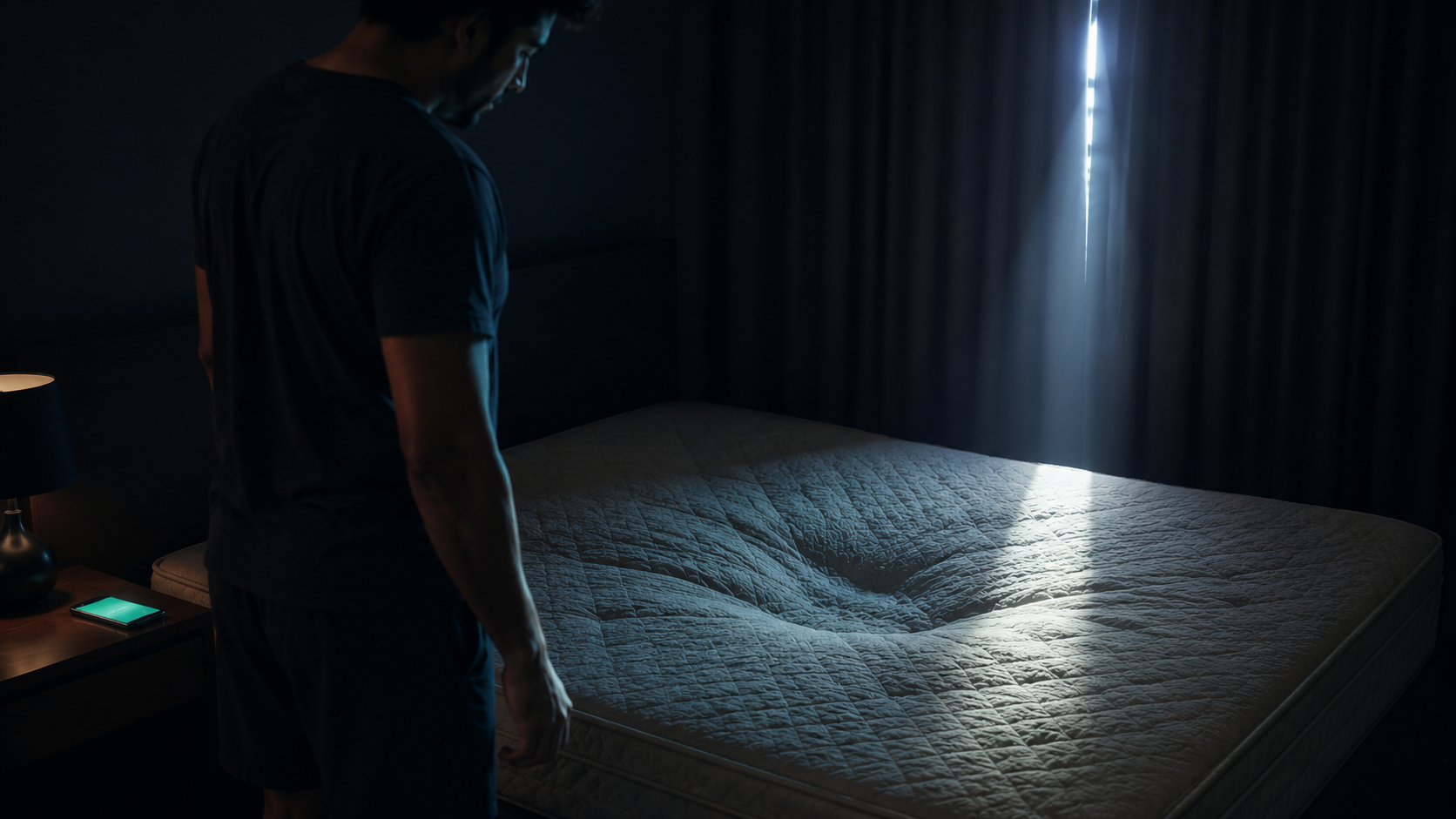
Most people suspect the mattress eventually. The back that tightens every morning. The heat that pulls them out of sleep at 2am. The feeling of waking up tired after nine full hours on a Sunday. But suspicion isn't diagnosis - and the mattress is easy to dismiss. It hasn't changed. You've had it for years. It still feels fine in the way that things you've stopped noticing feel fine.
The problem is that mattress failure is slow. It doesn't announce itself. It quietly chips away at the variables that make sleep restorative - until the baseline shifts enough that something feels wrong, but not wrong enough to point at a single cause. You adjust your caffeine, your screen time, your bedtime. The mattress stays invisible.
Here are the five signs worth paying attention to.
Sign 1: You Always Wake Up More Tired Than When You Slept
Sleep deprivation effects don't only come from not sleeping enough. They come from sleep that isn't deep enough - from cycles that get interrupted before they complete.
A mattress that creates pressure discomfort doesn't fully wake you up. It creates micro-arousals - brief moments where your brain surfaces just enough to register the sensation, then settles back down. You never know it happened. But over eight hours, those interruptions prevent you from spending enough time in the slow-wave and REM stages where actual restoration takes place.
The result mirrors what you'd feel after four hours on a good surface: foggy, slow, unrested. Except you slept eight hours. And because the sleep looked complete from the outside, you look elsewhere for the cause - late nights, stress, too much screen time before bed. The mattress stays out of frame.
If you're consistent about your sleep hours and consistently wake up unrestored, the surface is the variable worth examining before anything else. Sleep deprivation effects with no obvious lifestyle cause almost always have a structural explanation.
Sign 2: Your Back Hurts Every Morning - and Clears Up by Noon
Back pain due to mattress has a specific signature: it peaks on waking and eases as you move through the morning. This detail matters.
Stiff back in the morning that resolves during the day is not a spinal condition. A structural issue with your spine or discs doesn't switch off when you stand up and make tea. What does behave that way is postural stress from a surface that failed to hold your spine in neutral through the night.
When your mattress sags, softens unevenly, or pushes back with the wrong firmness for your body weight and sleep position, your lumbar muscles spend eight hours compensating. They hold the spine where the surface isn't supporting it. By morning, they've been working all night. Waking up with back pain that's gone by 11am is those muscles finally getting to release - not a coincidence, not age.
Back pain after sleeping that clears by midday, lower back pain after waking up, that familiar tightness when you reach for the alarm - this is the clearest of the five signs. If the pain follows this pattern - present at 7am, manageable by 10am, mostly gone by noon - the mattress is the most likely cause. Not your posture. Not your age. The surface you spent eight hours on.
Sign 3: You're Sweating in Bed Even With the AC On
If you're sweating in bed at 2am with the room at 24 degrees, the heat isn't coming from the air. It's being generated between your body and the surface beneath you.
Most mattress foam is a closed-cell structure. It absorbs and retains heat from your body through the night rather than dispersing it. As body temperature at the surface climbs, your core temperature rises with it - and your body needs to drop its core temperature to enter and sustain deep sleep. The surface and the sleep are working against each other.
An AC cools the air in the room. It doesn't touch the thermal environment at the surface level, which is where you actually sleep. So you turn the thermostat down, kick off the covers, switch to lighter sheets - and still wake up damp at the collar. The room is cold. The mattress isn't.
Sign 4: Your Body Is Sore and the Soreness Keeps Building Through the Week
This sign is most obvious in people who train regularly - but it affects anyone whose mattress creates sustained pressure on the same muscle groups night after night.
A surface that concentrates load at pressure points - hips, shoulders, lower back - keeps those muscles at low-level activation through the night. They don't fully decompress. The repair cycle doesn't complete. You wake up with residual soreness that's manageable on Monday and compounding by Thursday.
For people who work out, this looks like recovery that's always one session behind - rest days that don't work, soreness that never fully clears before the next session. For people who don't train, it shows up as general body heaviness in the morning, the sense of having been tense all night rather than at rest.
Sign 5: Your Sleep Has Been Getting Lighter for Months
This is the most overlooked sign because it happens too gradually to feel like a single event.
Mattress materials degrade. Foam compresses, support layers lose tension, the surface that once held your body correctly slowly stops doing it. The change is incremental - you don't notice the difference between Tuesday and Wednesday. You notice it when someone asks how you've been sleeping lately and you realise you can't remember the last time you slept deeply.
The markers are subtle: you start waking at small sounds you used to sleep through. Your sleep feels more restless. You roll more often through the night, searching for a position that used to come automatically. You wake once or twice where you used to sleep straight through. None of these are dramatic enough, on their own, to point at the mattress.
But collectively, they describe a surface that's lost the structural properties it had when new. Which mattress is best for sleep becomes a relevant question not because you want an upgrade - but because the surface you're on is no longer the one you bought. The gradual worsening over months is the mattress telling you something, just quietly enough that most people spend another year not listening.
If three or more of these signs are familiar, the common variable is the sleep surface. Not stress, not screen time, not caffeine - all of which you've likely already adjusted. The mattress is the one variable that typically gets examined last, if at all. And for the best mattress for back pain, for heat regulation, for pressure relief and recovery - the surface specification matters more than most people realize when they're standing in a showroom for ten minutes.
The ErgoGRID™ layer in Hafën is built to address the mechanisms behind all five signs - 4,000+ open-air channels for continuous heat dissipation, zone-responsive support that holds spinal alignment without creating pressure points, and a structure that maintains those properties over time rather than compressing into a uniform surface that treats every part of your body the same.
Hafën carries IGR certification and TÜV certification - both built around recovery outcomes, not showroom comfort.
Hafën's 120-days trial exists because surface adaptation takes time. Your body needs several full sleep cycles - not a ten-minute showroom test - to tell you whether the surface is actually working.
FAQ
1. How do I know if back pain in the morning is caused by my mattress?
The clearest indicator is timing. Back pain due to mattress peaks on waking and eases within two to three hours of being upright and moving. Pain from a structural spinal issue doesn't behave that way - it persists through the day or worsens with activity. If your stiff back in the morning is gone by noon, the surface is the most likely cause, not your spine.
2. How long should a mattress last before it starts affecting sleep?
Most mattresses begin to lose structural support between five and seven years, though this varies with foam density and construction quality. The more reliable signal is whether your sleep quality has declined over the past six to twelve months. Gradual worsening - lighter sleep, more frequent waking, more morning stiffness - is a better indicator than age alone.
3. Can a bad mattress cause sleep deprivation effects even if I sleep eight hours?
Yes. Sleep deprivation effects aren't only caused by short sleep duration - they're also caused by insufficient deep sleep. A mattress that creates pressure discomfort interrupts deep sleep cycles through micro-arousals you won't remember in the morning. Eight hours of fragmented sleep delivers significantly less restoration than eight hours of uninterrupted sleep cycles.
4. What is the best mattress for back pain?
The best mattress for back pain holds your spine in neutral alignment for your body weight and sleep position, distributes load evenly so no muscle group stays under sustained pressure, and maintains those properties over time. A surface too firm creates pressure points at the hips and shoulders; one too soft lets the spine sag. Zone-responsive support - different firmness at different load points - is the structural feature most directly relevant to morning back pain.
Share:
Why Your Body Still Feels Sore Even on Rest Days
The Best Sleeping Position for Back and Neck Pain, According to Sleep Science