
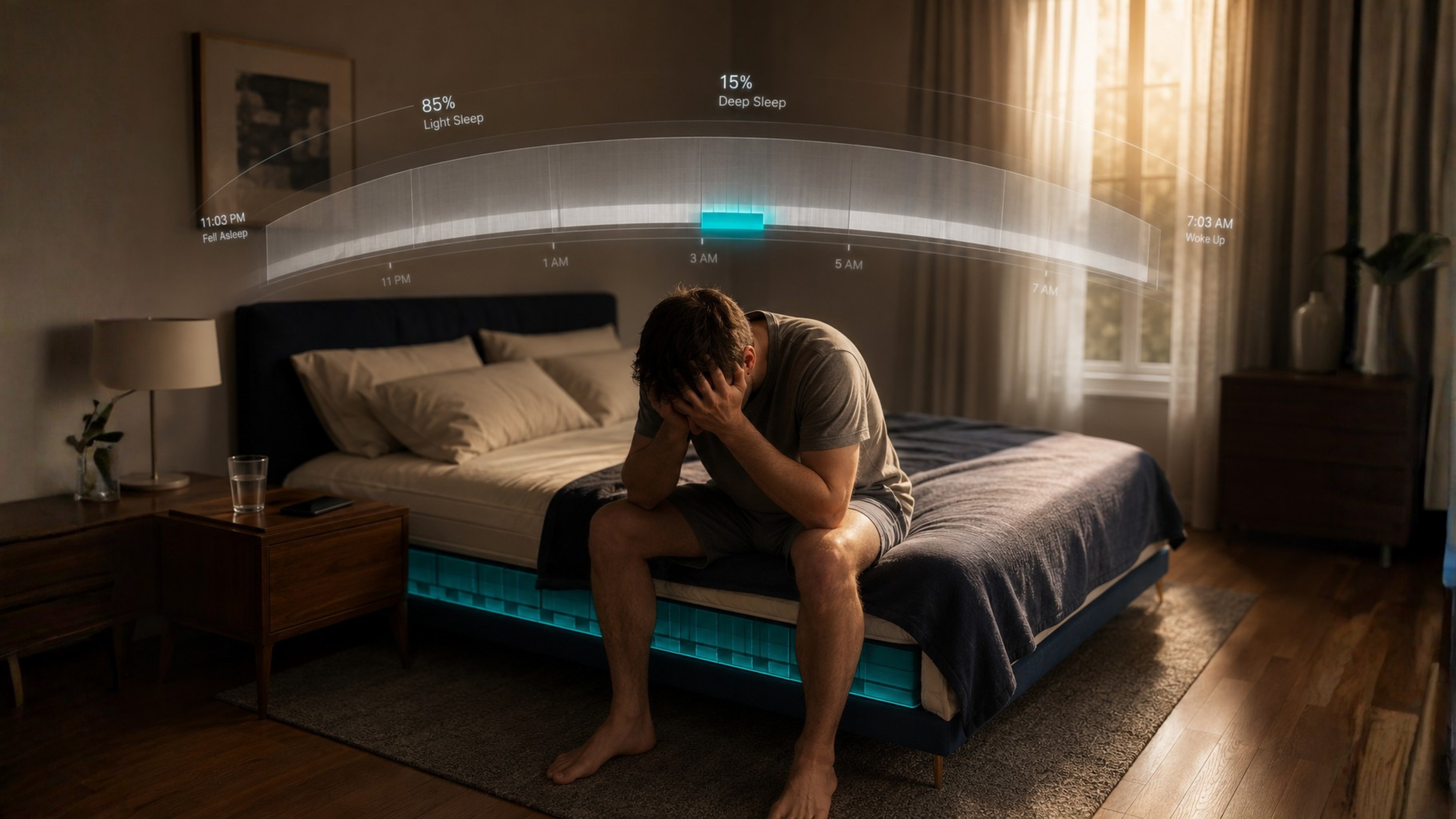
You set your alarm for 7am. You were in bed by 11. Eight hours, on paper. No late-night scrolling, no last-minute deadlines. You did everything right.
And yet when the alarm goes off, your body's first instinct is to ignore it. Not because you're lazy - you're genuinely not done. The grogginess isn't from staying up too late. You just don't feel rested, even though the math says you should.
If this is a regular morning for you, the answer isn't more sleep. Knowing how to improve sleep quality during the hours you already have changes everything and it starts with understanding what actually happens inside them.
Eight Hours Is a Starting Point, Not a Guarantee
The "get 8 hours" advice has been repeated so many times that most people treat it like a finish line. Once you cross it, you should feel fine. But sleep researchers have known for decades that hours alone don't determine how rested you feel. The quality of those hours does.
Here's what actually happens while you sleep: your brain cycles through four distinct stages - two lighter stages, deep sleep (technically called slow-wave sleep), and REM. You complete this cycle roughly 4 to 5 times a night. Each stage does something different, and they're not interchangeable.
Deep sleep is where the real work happens. Your body releases growth hormone, repairs muscle tissue, consolidates what you learned that day, and resets your immune system. REM handles memory and emotional processing. Light sleep is mostly a transition between them.
Adults typically need 1.5 to 2 hours of deep sleep per night - around 20 to 25% of their total sleep time. The problem is that most people assume they're getting it. If something disrupts your deep sleep - even without fully waking you - you'll spend 8 hours in bed and still wake up feeling like you only managed 4.
The 3 Physical Reasons You're Not Getting Deep Sleep
Most articles on this topic give you a list of ten things to fix and send you away overwhelmed. The reality is simpler: the factors most likely to reduce deep sleep without you realising it are physical, not psychological. And they all relate to what your body is doing while you're unconscious.
1. Your Body Temperature Isn't Dropping
To enter and stay in deep sleep, your core body temperature needs to fall by roughly 1 to 2 degrees Celsius. This isn't optional, it's the physiological trigger that allows your brain to shift into slow-wave activity. If your sleep environment is too warm, your body can't make that drop, and you stay stuck cycling through lighter stages instead.
This is easy to underestimate in India. Even with a ceiling fan or AC, the surface you're sleeping on can trap heat independently. A mattress that doesn't allow airflow turns into a heat sink within the first hour and the problem builds through the night, often peaking in the early morning hours when deep sleep is most needed.
2. Pressure Points Are Waking You Without You Knowing
This is one of the most overlooked reasons people feel unrested despite adequate hours: micro-arousals.
You don't have to fully wake up for your sleep to be interrupted. When certain parts of your body - hips, shoulders, lower back, bear disproportionate weight for too long, your nervous system registers discomfort. You shift position. You adjust. You never open your eyes, so you don't count it as waking. But every time it happens, you're exiting deep sleep.
These micro-arousals can occur dozens of times per night. You have zero memory of them. And they're why many people wake up after 8 hours feeling like they spent the night on a flight.
3. Your Muscles Are Working Instead of Resting
During sleep, your muscles are supposed to completely switch off. Your spine which spends the entire day compressed under the load of sitting, standing, and moving, needs those hours to decompress and recover.
But if your sleep surface doesn't support your body's natural alignment, your muscles don't fully let go. They continue making small adjustments through the night, holding your spine in place because the surface isn't doing that job. By morning, instead of feeling rested, your body feels like it's been working - because physiologically, it has been.
This is the most common reason people wake up with stiffness or a dull heaviness in their back or shoulders, even when they slept the full night.
A 2-Minute Check Before You Change Anything Else
Before you adjust your sleep schedule, cut out caffeine, or buy a new pillow, answer these three questions honestly:
-
Do you regularly sleep 7 to 8 hours but still feel tired in the morning?
-
Do you wake up with stiffness, soreness, or heaviness in your back or shoulders?
-
Has your mattress been the same one for 5 or more years?
Two yes answers point strongly to your sleep surface being part of the problem.
A mattress loses a significant portion of its structural support within 5 to 7 years - even when it doesn't visibly look worn. The change is gradual, so you adapt to it slowly, never identifying the exact point where your sleep started getting worse. But the body keeps the score: morning tiredness and physical stiffness together are one of the clearest signals that your surface is no longer doing what it should.
What "sleep-optimized" actually means
"Comfortable" and "sleep-optimized" are not the same thing.
Comfort is what you feel in the first 60 seconds of lying down. Sleep quality is what happens over the next 7 to 8 hours while you're completely unconscious. You can have a mattress that feels luxurious when you climb in and still significantly disrupt your deep sleep through the night. Most people don't make this distinction because they've only ever evaluated a mattress awake.
A surface that genuinely supports deep, restorative sleep needs to do three specific things:
Support your body in zones, not uniformly. Your shoulders need to sink in. Your lower back needs firmer resistance to stay aligned. Your hips need cushioning without sagging. A single-density foam applies the same pressure everywhere - which means it gets some areas right and compensates poorly for others. Zonal construction allows your body to fully decompress without your muscles having to make up the difference.
Move heat away from your body, not just let it breathe. Breathable fabric is not the same as active airflow. A surface that genuinely supports the temperature drop your body needs for deep sleep has to move heat through the mattress, not just sit passively.
Distribute your body's weight evenly. Not softness - distribution. When pressure is uneven, certain points bear more load than they should, triggering those micro-arousals through the night. Even pressure across the surface means your nervous system stays calm, and your sleep stays deep.
This is the thinking behind Hafën. The ErgoGRID layer is engineered specifically for zonal support - responding differently to your shoulders, back, and hips as your body needs - while over 4,000 air channels work through the night to keep your sleep surface temperature neutral. It's why Hafën is the first mattress in India to receive IGR certification, a standard built specifically around recovery sleep, not just general comfort.
Questions We Get Asked a Lot
1. Why do I feel sleepy even after sleeping 8 hours?
The most likely reason is insufficient deep sleep. Deep sleep is the stage where your body physically repairs itself - and several factors can reduce it without ever fully waking you. Heat trapped by your sleep surface, uneven pressure creating micro-arousals, and poor spinal support are among the most common culprits, and all of them operate invisibly through the night.
2. What's the difference between sleep quality and sleep quantity?
Sleep quantity is how many hours you're asleep. Sleep quality is how those hours are distributed across sleep stages - specifically how much time you actually spend in deep sleep and REM. Eight hours of poor-quality sleep can leave you more exhausted than six hours of genuinely restorative sleep.
3. How do I increase deep sleep naturally?
Keep your sleep and wake times consistent, even on weekends. Keep your bedroom cool - ideally between 18 and 20°C. Avoid alcohol close to bedtime, which fragments the second half of your sleep cycle. And seriously evaluate your sleep surface - pressure, heat, and poor support are among the most underestimated causes of reduced deep sleep and the easiest to fix without medication or lifestyle overhaul.
4. Can a mattress really affect sleep quality?
More than most people expect. A mattress that creates pressure points, traps heat, or doesn't support spinal alignment causes micro-arousals - brief exits from deep sleep that you never consciously remember but wake up feeling. The right surface doesn't guarantee perfect sleep, but the wrong one can consistently prevent it.
5. How much deep sleep do I actually need?
Most adults need between 1.5 and 2 hours of deep sleep per night, roughly 20 to 25% of total sleep time. If you're regularly sleeping 8 hours but waking up unrefreshed, tracking your sleep stages through a wearable can be eye-opening - many people discover they're getting half or less of the deep sleep their body needs.
Where to Go From Here
Eight hours is just the beginning of the question. What happens inside those hours - how your body moves through sleep stages, how much time it actually spends in deep sleep, and how fully it recovers is what determines how you feel when you wake up.
If you've been sleeping long enough but not waking up rested, your sleep surface is worth a serious look. Hafën's 120-night trial is built for exactly this purpose: not to convince you in one night, but to give your body enough time to show you the difference between sleeping and actually recovering.
Share:
Why You Wake Up With a Stiff Neck Every Morning (And Why the Pillow Isn't the Problem)