
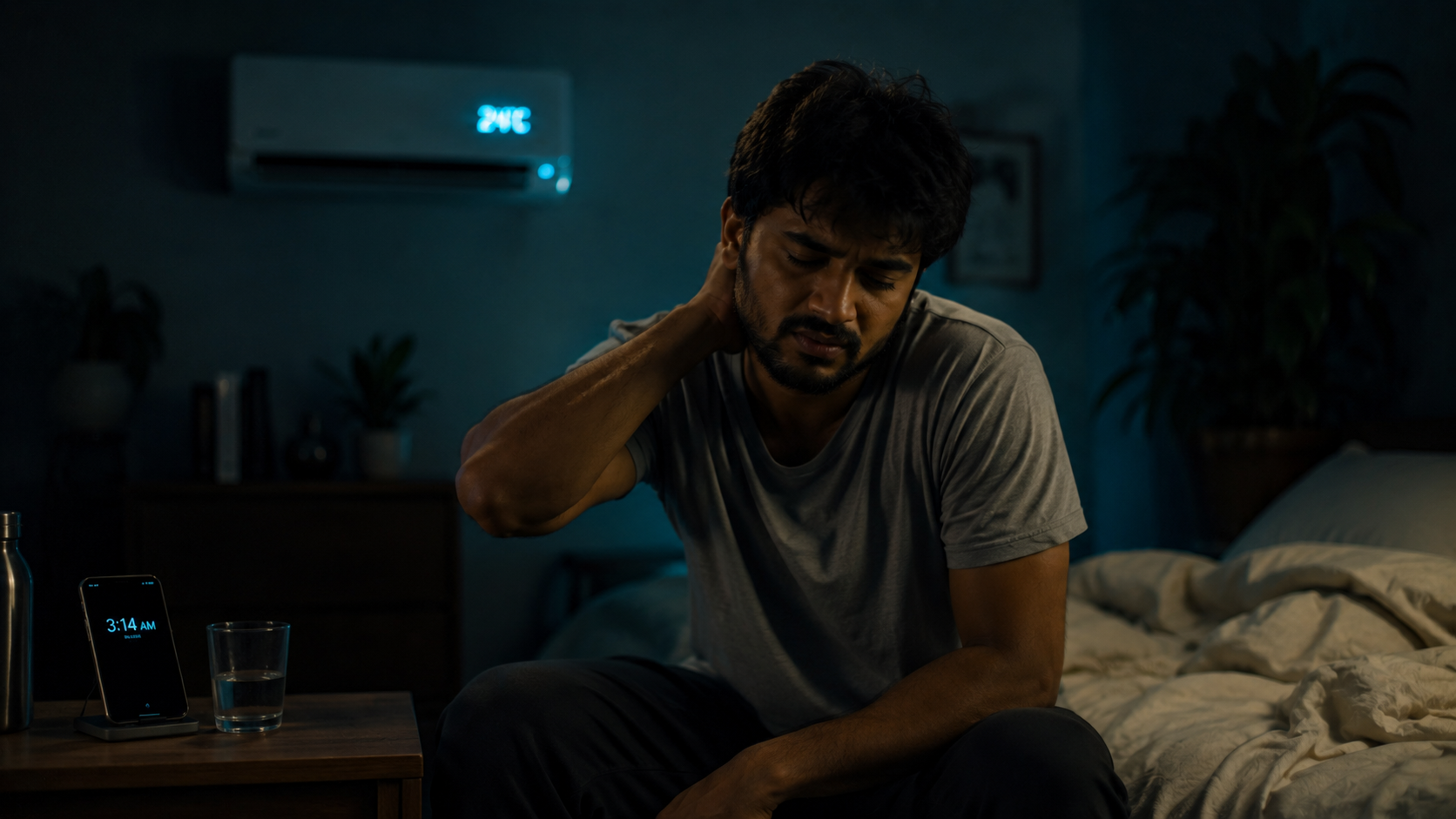
You know the exact moment. It's somewhere around 3am, and you wake up not from noise or a bad dream, but from heat. The sheet beneath you has gone damp. The back of your neck is clammy. You reach for the AC remote on the nightstand - 24 degrees, exactly where you set it before bed.
So why are you still sweating in your sleep?
The room isn't hot. The AC has been running all night. And yet here you are, somewhere between Monday and Thursday - it always seems to get worse as the week goes on - lying in a damp patch on your side of the bed and wondering what you're supposed to do about it. Turning the temperature to 18 crosses your mind briefly, then you remember the electricity bill.
Here's the thing: the AC isn't the problem. And neither, precisely, are you. What's happening has a clear mechanical explanation - and once you understand it, the fix becomes obvious.
Your Body Is Sweating to Sleep, Not Because Something Is Wrong
Most people assume that sweating while sleeping means something is off - too much stress, too much food, something hormonal. Sometimes those things are factors. But for the majority of people waking up sweaty in a warm, humid climate, the cause is simpler and more mechanical than that.
To move into deep sleep - and stay there - your core body temperature needs to fall by roughly 1 to 1.5 degrees Celsius. This isn't a minor preference your body has. It's the physiological trigger that allows your brain to shift into slow-wave sleep, the stage where real recovery happens: muscle repair, immune response, memory consolidation. Without that temperature drop, your system keeps cycling through lighter sleep stages, never fully descending.
When your body can't shed heat fast enough, it does what it always does: it sweats. Sweating while sleeping isn't a malfunction. It's your thermoregulation working correctly, trying to force the temperature drop your body needs to sleep properly. The question is what's making that job harder than it should be.
The AC is Cooling the Air. You're Not Sleeping in Air.
This is the part that trips everyone up.
For seven or eight hours, you're lying on a surface. That surface - your mattress - has been absorbing your body heat since the moment you lay down. Dense foam, which dominates the Indian mattress market, behaves like a thermal sponge: it absorbs heat, compresses it, and gradually radiates it back upward. Directly into your body.
Your AC is doing exactly what it was designed to do: cooling the air in the room. But the air is 20 centimetres above you. The surface temperature - the microclimate right at the boundary between your body and the mattress - is a different story entirely. Within the first hour, a foam surface can be several degrees warmer than the air temperature. By hour three, you're essentially lying on a slow heat radiator.
That's why you wake up sweating in bed at 3am and not at 11pm. The heat accumulates gradually. By the time it's significant enough to disrupt your sleep - pulling you up out of deep sleep, triggering your nervous system to sweat - you've been asleep for hours and have no idea what woke you. You just know you're hot and the AC is on and none of it makes sense.
It makes sense now.
In Kerala, Sweating Itself Stops Working
The physics of sweat as a cooling mechanism depend entirely on one thing: evaporation. Sweat cools your skin when it evaporates off the surface. In dry climates, this happens quickly and efficiently. In humid ones, it barely happens at all - because the air is already saturated close to its maximum moisture capacity.
Kerala's average humidity stays above 75% for most of the year. During the monsoon months, it pushes higher. In those conditions, sweating at night while sleeping becomes a self-defeating loop: your body produces sweat to cool down, but the sweat can't evaporate, so your skin stays damp, your body temperature stays elevated, and your body produces more sweat in response.
The reasons for night sweats here aren't mysterious - the environment has closed off your body's main escape route. And most mattresses sold in India were not designed for this climate. They were designed for temperate conditions, or designed without climate in mind at all.
If you moved from a drier city and noticed your sleep quality drop, or if you sleep noticeably worse during the monsoon than in winter, this is a significant part of why.
Why the Problem Always Gets Worse by Thursday
One night of overheated sleep and you recover. Three in a row and the deficit starts showing.
Every night your core temperature can't drop properly, your deep sleep suffers. The repair work your body needs to do still happens - but with less time and lower efficiency. You wake up each morning slightly behind where you should be. By Thursday evening, you're carrying four nights of accumulated thermal debt: more irritable, less focused, more tired than you were on Monday despite technically sleeping every night.
Sweating during sleep is easy to write off as a single-night inconvenience. The damage is cumulative, and by the end of the working week it has compounded into something your body can't quietly absorb anymore.
What the Fix Actually Looks Like
The fix isn't in the thermostat. It's in the surface.
A mattress that genuinely supports thermal regulation needs to do more than use breathable fabric. Breathable fabric manages the feel of the surface - it doesn't move heat through the structure. What you actually need is active airflow: channels that allow warm air to move away from your body as heat rises, rather than pooling and re-radiating at the contact zone.
The ErgoGRID™ layer in Hafën is built with over 4,000 open-air channels precisely for this. They don't just make the surface cooler to touch - they create ongoing thermal dissipation through the mattress structure across the entire night, preventing the heat accumulation that disrupts sleep in the second and third hours. It's part of why Hafën carries IGR certification and TÜV certification, both built around measurable recovery outcomes rather than how a mattress feels in the first 60 seconds.
If you're sweating at night while sleeping despite an AC running all night, the answer isn't a colder room. It's a surface that stops making your body's cooling job harder than it needs to be. Hafën's 120-night trial exists so your body - not a 10-minute showroom test - gets to make that call.
Questions People Ask About This
1. Is sweating while sleeping something to worry about medically?
For most people in a warm, humid climate, sweating while sleeping is a thermal and environmental issue - not a medical one. If it's mild-to-moderate, improves in cooler conditions, and isn't accompanied by fever, unexplained weight loss, or symptoms like a racing heart or breathlessness, the cause is almost certainly your sleep surface and environment. Those other symptoms are worth a conversation with a doctor; a damp back at 3 am in a Kerala summer usually isn't.
2. Why do I only sweat in the second half of the night?
This is the heat-sink effect building over time. Your mattress surface temperature rises gradually through the first 1–2 hours of sleep, reaching its peak just as your body enters its longest deep sleep cycles - which fall in the second half of the night. The disruption arrives exactly when your body needs the most from its surface.
3. Does turning the AC lower actually help?
Somewhat - but it addresses the air, not the surface. Most people who drop the AC to 18°C find they're cold for the first hour, then wake up hot again at 3 am anyway. The surface has been absorbing and radiating body heat regardless of what the air temperature reads.
4. Is this fixable if you live somewhere like Kerala?
Yes - but the fix needs to address two things at once: the surface that traps heat, and the humid air that stops sweat from evaporating. A mattress with structural airflow handles the surface problem. A ceiling fan or good room ventilation helps with evaporation. Together, they close the loop the AC alone was never going to close.
Share:
Why You Wake Up With a Stiff Neck Every Morning (And Why the Pillow Isn't the Problem)
Why Your Body Still Feels Sore Even on Rest Days