
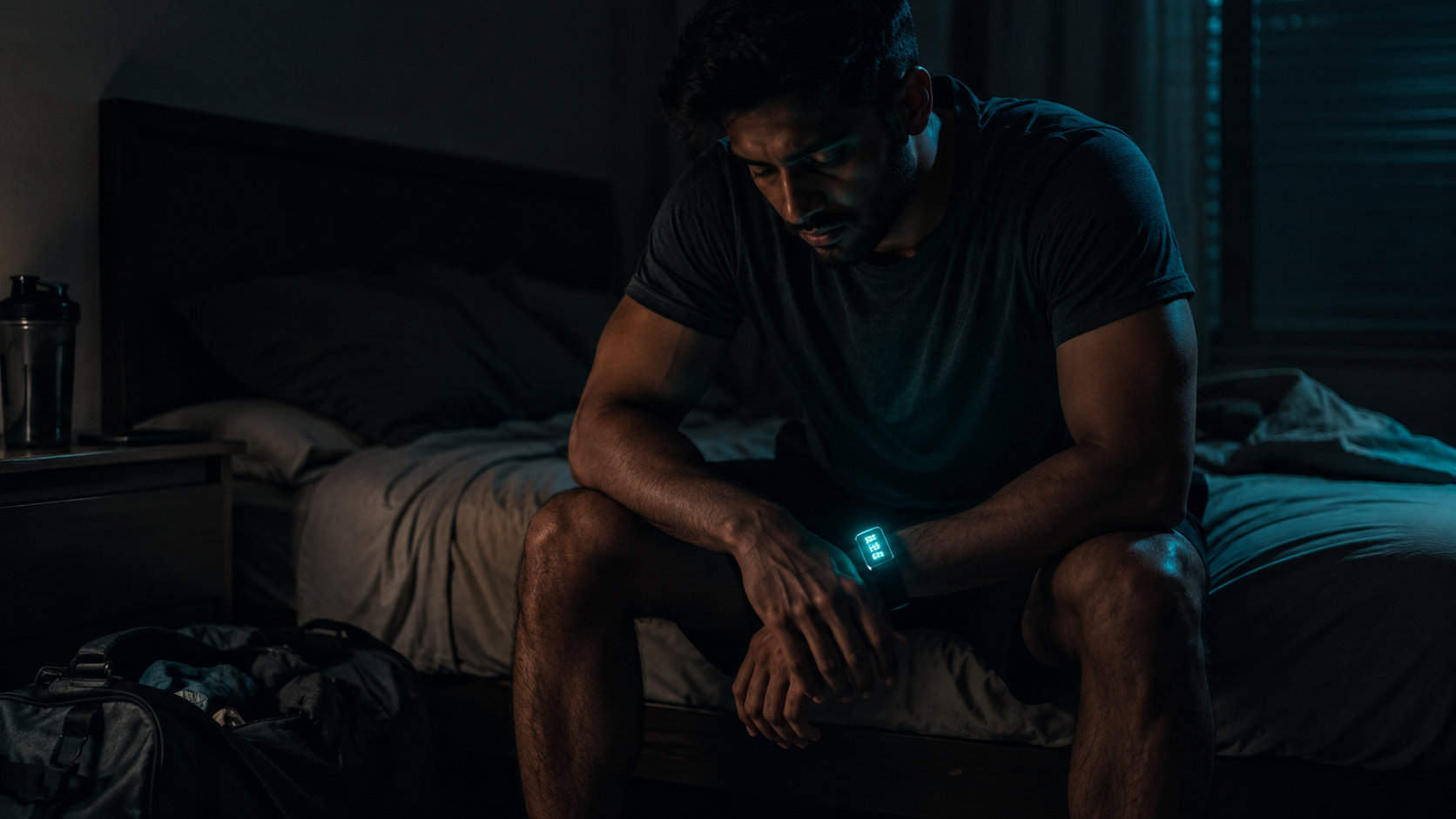
You took the day off. No gym, no run - just rest. And your legs still ache going down the stairs. Your shoulders still feel like you trained yesterday. If muscle pain after workout was supposed to clear up on rest days, why does it keep building through the week?
The answer isn't in your workout. It's in what happens after it.
Muscle Recovery Doesn't Happen on Rest Days - It Happens During Sleep
Rest days reduce load. Sleep does the repair.
When you train, you create micro-tears in muscle fibres - that's the whole point. The body rebuilds them stronger. But the rebuilding doesn't happen the moment you stop lifting. It happens during deep sleep, when your pituitary gland releases growth hormone in pulses. This is when muscle protein synthesis peaks, inflammation markers drop, and the actual structural repair takes place.
Without sufficient, uninterrupted deep sleep, muscle recovery stalls - regardless of how many rest days you take. You can sit on the couch all Sunday and still wake up Monday feeling like you trained twice on Saturday. Rest days create the space. Sleep is where the work gets done.
This is the part most training advice skips. Nutrition, hydration, foam rolling - all useful. But none of them trigger the hormonal cascade that actually rebuilds damaged muscle. Only deep sleep does that. Which means if your sleep is getting disrupted, the rest of your recovery stack is working around a gap it can't fill.
How Delayed Onset Muscle Soreness Disrupts Your Sleep
Here's where it compounds. Delayed onset muscle soreness - the stiffness that peaks 24–48 hours after training - doesn't just hurt during the day. It actively disrupts the sleep that would otherwise repair it.
DOMS increases pressure sensitivity in muscle tissue. When you lie down, whichever part of your body bears weight against the mattress becomes uncomfortable - hips, shoulders, lower back, wherever you carried the training load. That discomfort creates micro-arousals: brief moments where your brain surfaces just enough to register the pressure signal, without you fully waking up. You never know it happened. But your sleep architecture does.
These micro-arousals interrupt deep sleep cycles. You get less time in the slow-wave stages where growth hormone is released. Less growth hormone means less muscle repair. And less muscle repair means the delayed onset muscle soreness is still there tomorrow night, still disrupting the next sleep cycle. The loop closes on itself.
Most people don't connect these two. They feel more wrecked than expected by Wednesday and assume they overtrained. They didn't. They under-recovered and the bottleneck was sleep quality, not training volume.
The Surface You're Sleeping On Is Either Helping or Blocking Recovery
Your sleep surface determines how much pressure your muscles absorb over eight hours. That has a direct effect on whether those micro-arousals happen.
A surface that's too firm concentrates load at pressure points - hips, shoulders, the side of your knee. Those muscles never fully decompress. They stay at low-level activation all night, which means they're not actually at rest, and the repair signal doesn't fully engage. A surface that's too soft lets the body sink unevenly, creating spinal misalignment that adds its own tension to postural muscles.
The right surface distributes body weight so no single muscle group is under sustained pressure through the night. For someone sedentary, an average mattress is often fine. For someone in active training, the margin matters more - because body aches after workout are already elevated, so the sleep surface is either extending the recovery window or compressing it.
There's a thermal layer too. A mattress that traps heat raises your core body temperature through the night. Your body needs to drop its core temperature to enter and sustain deep sleep. Heat retention from the sleep surface fights that drop - lighter, shorter deep sleep cycles, and with them, less growth hormone release. The two mechanisms stack.
Why Sore Muscles After Gym Keep Getting Worse Through the Week
Monday's soreness should be mostly clear by Wednesday. If it isn't, if you feel progressively worse by Thursday or Friday, stacking new training on top of soreness that never fully clears - that's a recovery deficit compounding night after night.
Each disrupted night means you carry more unrepaired muscle damage into the next session. Add another workout on incomplete recovery, and the soreness goes deeper. Sore muscles after gym that compound through the week, rather than clearing session by session, almost always have a sleep quality component. The pattern is the tell.
Most people at this point reduce training volume, take extra rest days, or look at their diet. Those adjustments have a ceiling if the underlying issue is poor deep sleep. You can train less and eat better, but if every night you're getting broken light sleep instead of sufficient deep sleep, the repair deficit still builds. Just more slowly.
How to Reduce Muscle Soreness - It Starts With Your Sleep Surface
The standard post-workout recovery advice - hydrate, stretch, cold exposure, active recovery -- helps at the margins. None of it addresses what happens during the eight hours your body is actively trying to repair itself.
How to reduce muscle soreness more effectively means protecting the conditions under which deep sleep can do its job. That starts with the sleep surface.
Pressure distribution. A surface that holds your body without concentrating load at any point means no micro-arousals from pressure discomfort. Spinal alignment. Postural muscles held in neutral through the night aren't adding tension to a system that already has plenty. Thermal management. A mattress that moves heat away from the body lets core temperature drop on schedule - which is when deep sleep begins.
The ErgoGRID™ layer in Hafën is built around exactly this - 4,000+ open-air channels that manage thermal load continuously through the night, paired with zone-responsive support that decompresses pressure points as you sleep.
Hafën carries IGR certification and TÜV certification, both built around measurable recovery outcomes - not comfort ratings.
Hafën's 120-night trial exists because real recovery isn't something you feel on the first night - it compounds across training cycles.
If you're in a consistent training schedule, the compounding effect of fixing your sleep surface is disproportionate. Not because the mattress repairs your muscles directly - but because it protects the window where your body does. Every good night is a full repair cycle. Every disrupted night is a deficit. Over weeks and months, that gap shows up in how your body feels going into every session.
Muscle soreness isn't the problem. Accumulated, unresolved muscle soreness is. And the place to fix that isn't the gym - it's the eight hours before you get back to it.
FAQ
1. Does muscle soreness mean my workout was effective?
Muscle soreness is a sign of muscle fibre damage from training - it means your body has something to repair. But soreness intensity doesn't directly correlate with workout quality. You can have an effective session with minimal DOMS, especially as your body adapts to a consistent training load. The repair process is what builds strength, not the soreness itself.
2. How long should muscle pain after workout last?
Delayed onset muscle soreness typically peaks 24–48 hours after training and clears within 72 hours for most people. If muscle pain after workout persists beyond three days, or compounds through the week rather than clearing, disrupted deep sleep is usually a contributing factor - the repair cycle is getting cut short each night.
3. Can sleeping on the wrong mattress cause body aches after workout?
Yes. Body aches after workout that don't resolve overnight are often worsened by a sleep surface that creates pressure points or fragments deep sleep. Sore muscles under sustained pressure all night without full deep sleep cycles - don't fully repair before the next day. The surface isn't causing the soreness, but it's preventing the clearance.
4. Is rest or sleep more important for muscle recovery?
Sleep. Rest days reduce training load, but muscle recovery happens primarily during deep sleep - through growth hormone release and muscle protein synthesis. You can take a full rest day and still run a recovery deficit if your sleep quality is poor. Rest creates the opportunity. Sleep is where the actual repair work happens.
Share:
Why You Sweat So Much in Your Sleep - Even With the AC On
5 Signs Your Mattress Is Silently Ruining Your Sleep