
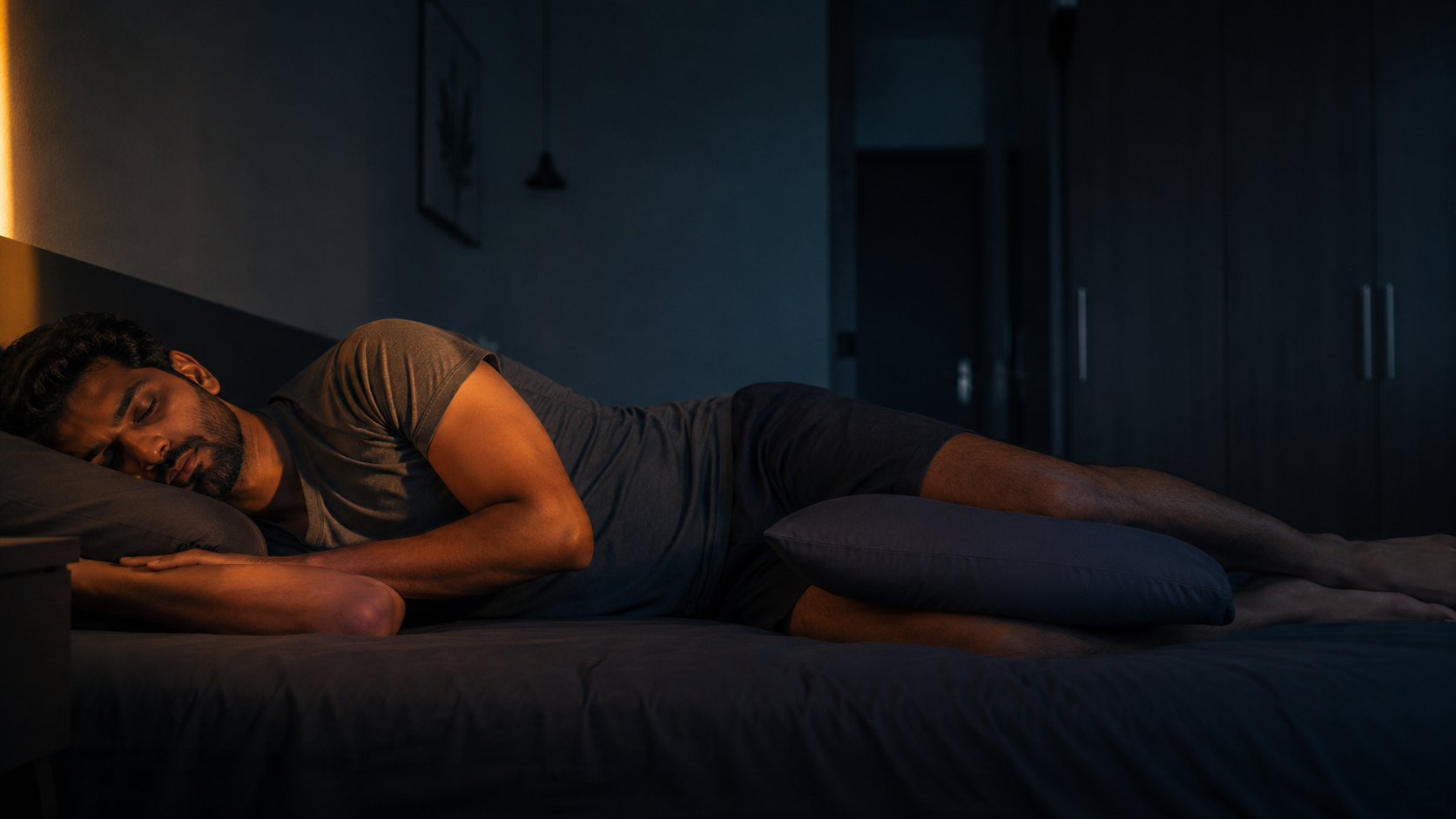
The best sleeping position for back and neck pain is on your back with a pillow under your knees, or on your side with a pillow between your knees. Both keep your spine neutral while your muscles decompress overnight. Stomach sleeping does the opposite - it locks your lumbar into extension and forces your neck into rotation for hours at a stretch.
That's the short answer. But if you've been sleeping in the right position for months and still wake up stiff, the problem isn't which side you're on. It's what happens to that position when your mattress doesn't hold it.
Why does your sleeping position affect your back and neck this much?
Your spine isn't rigid. It has three natural curves - the cervical curve at your neck, the thoracic curve through your mid-back, and the lumbar curve at your lower back. When you stand, these curves distribute your bodyweight evenly. When you lie down, gravity and your sleep surface take over that job.
If your position or surface collapses any of those curves - even slightly - the muscles along your spine don't get to fully switch off. They stay in low-grade tension throughout the night, bracing against a posture they can't correct. You wake up having slept eight hours, but your back spent those eight hours working.
Your neck is the most vulnerable part of this chain. The cervical spine supports the weight of your head - around 5-6kg - and it's designed to do that in one very specific alignment. A few degrees of rotation held for six hours creates the kind of tension that shows up as stiffness every morning without a clear cause.
What is the best sleeping position for back pain and neck pain?
Two positions consistently reduce spinal load during sleep. Neither is complicated.
| Sleeping Position | Back Pain Impact | Neck Pain Impact | Best For | Watch Out For |
|---|---|---|---|---|
| Back sleeping (supine) | Excellent - distributes weight evenly | Excellent - neutral cervical alignment | Lower back pain, general pain relief | Snoring, sleep apnea |
| Side sleeping with pillow between knees | Good - keeps hips aligned | Good - requires correct pillow height | Hip pain, pregnancy, acid reflux | Shoulder pressure if pillow is wrong |
| Side sleeping without knee pillow | Moderate - hips can rotate | Moderate | - | Upper hip creates spinal twist |
| Fetal position (tight curl) | Poor for lower back | Moderate | - | Compresses lumbar discs |
| Stomach sleeping (prone) | Poor - flattens lumbar curve | Poor - forces neck rotation | None recommended | Neck and lower back strain |
Back sleeping is the gold standard for spinal alignment. When you lie flat on your back, your weight spreads across the entire surface of your back, no single point takes excessive load, and your neck can rest in its natural curve without rotation. A pillow under your knees takes the remaining tension off your lower back by restoring the lumbar curve's natural angle.
Side sleeping is the more common position, and done correctly, it works well. The critical detail is the pillow between your knees. Without it, your upper leg drops forward and rotates your hip - pulling your lumbar spine into a twist that holds for hours. With it, your hips stay stacked and your spine stays long.
Which sleeping position is silently making your pain worse?
Stomach sleeping. Every night.
When you sleep face down, your lumbar spine flattens against the mattress - the opposite of its natural curve. Your neck has no choice but to rotate 45-90 degrees to one side, because you can't breathe into a pillow. That rotation is held for six, seven, eight hours.
The muscles at the back of your neck - the suboccipitals and the upper trapezius - spend the night in a shortened, contracted position. The muscles along your lumbar spine are stretched and compressed in the wrong direction. Neither group gets the decompression sleep is supposed to provide.
If you wake up with neck pain by Wednesday and it wasn't there Monday, and you're a stomach sleeper, you've found your answer. The pain doesn't announce itself immediately. It accumulates across the week.
Breaking a stomach sleeping habit is hard, mostly because it's unconscious. A pillow placed against your front, or a rolled towel under your hip, can make the position uncomfortable enough that your body self-corrects through the night.
Why does the right position still fail on the wrong mattress?
This is the part most sleep advice skips.
Your sleeping position is only effective if your surface holds it. A back sleeper on a mattress that sags in the middle doesn't actually sleep in neutral alignment - they sleep in a hammock curve, where their lumbar drops into flexion and stays there. A side sleeper on a surface that's too firm gets their shoulder pushed inward, creating a compensatory curve through their entire thoracic spine.
The position is the intent. The mattress is what either supports or defeats it.
The Hafën ErgoGRID™ was designed around this problem. The 4,000+ open air channels in the ErgoGRID layer respond to pressure differentials - firmer where your hips and shoulders need support, softer where your lumbar needs to float. The result is that your position - whichever one you're in - is actually maintained through the night, not gradually collapsed.
Hafën holds IGR certification, the first mattress brand in India to do so, alongside TÜV certification - both independent validations of the support claims, not marketing language. If you want to test whether it actually holds your position the way it should, the 120-night trial gives you enough time to know.
How does sleeping position connect to other sleep problems?
Position affects more than just back and neck pain. If you've been waking up tired after a full night's sleep - something we covered in why you're still tired after 8 hours - your position may be part of why your body never fully offloads overnight.
Night sweats can also be position-related. Stomach sleeping traps heat between your body and the mattress surface. Side sleeping on a foam mattress without airflow channels does the same - the reason sweating in your sleep even with the AC on often comes down to surface material, not room temperature.
And if you're waking up with a stiff neck every morning, your sleeping position is rarely the only cause - but it's always part of the chain.
Frequently Asked Questions
1. What is the best sleeping position for lower back pain?
Back sleeping with a pillow under your knees is the most effective position for lower back pain. It distributes spinal load evenly and restores the lumbar curve's natural angle, allowing the muscles along your lower back to fully relax overnight.
2. Is it better to sleep on your back or your side for back pain?
Both are effective, but for different reasons. Back sleeping provides the most even weight distribution. Side sleeping with a pillow between your knees is better for people who also have hip pain or who can't maintain back sleeping through the night. The pillow between your knees is non-negotiable for side sleeping - without it, your spine rotates.
3. Can sleeping position cause neck pain?
Yes. Stomach sleeping is the primary culprit - it forces your neck into sustained rotation for hours. Even back or side sleeping with the wrong pillow height can misalign your cervical spine. Your pillow should keep your head in the same position it would be if you were standing - not tilted up or dropped down.
4. What is the worst sleeping position for back pain?
Stomach sleeping. It flattens the lumbar curve, forces neck rotation, and prevents spinal muscles from decompressing overnight. If you're a habitual stomach sleeper with back or neck pain, this is the single most impactful change you can make.
5. Should I sleep with a pillow under my knees?
If you're a back sleeper with lower back pain, yes. A pillow under your knees takes tension off the lumbar spine by tilting your pelvis into a more neutral position. The difference is significant enough that most people feel it within the first few nights.
6. Can a bad mattress cancel out a good sleeping position?
Yes, completely. A mattress that sags or lacks zonal support will gradually pull your body out of the position you started in. The position is the intent - the mattress determines whether it holds through the night.
7. How long does it take to adjust to a new sleeping position?
Most people take 2-4 weeks to stop reverting to their old position unconsciously. Using a body pillow or rolled towel to block your habitual position speeds up the adjustment. Discomfort in the first week is normal - it's your body adapting, not a sign the new position is wrong.
8. Does sleeping position affect disc problems?
Yes. Stomach sleeping increases disc pressure in the lumbar region. Back sleeping with a knee pillow and side sleeping with a hip-level pillow both reduce disc pressure. If you have a diagnosed disc issue, back sleeping is typically the first recommendation.
Share:
5 Signs Your Mattress Is Silently Ruining Your Sleep